
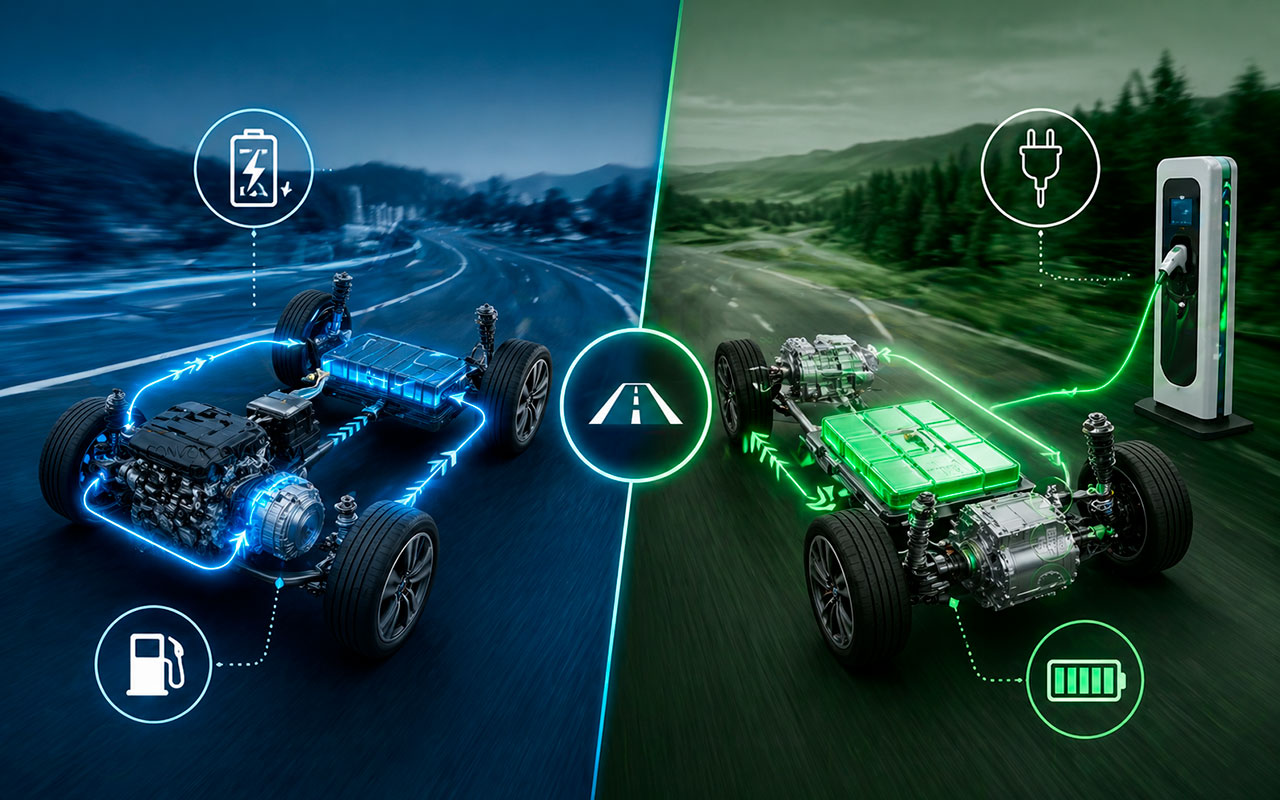

Toyota Corolla Hybrid GLi - For reader Jailson, who drives about 1,000 km per month (roughly 800 km on highways and 200 km in the city), the practical consequence is immediate: a conventional hybrid is generally the smarter, more predictable choice for heavy road use.
- In short: With 80% highway driving, the Corolla Hybrid GLi typically delivers lower real-world consumption and greater resale reliability than the BYD Song Pro PHEV.
Why highway duty favors a conventional hybrid
The Corolla GLi uses a full hybrid (HEV) system that never needs external charging and is tuned to deliver steady efficiency across different speeds. The BYD Song Pro is a plug-in hybrid (PHEV) whose official electric range for the Song Pro GS is 62 km (Inmetro), but that figure is measured in mixed or urban cycles and falls under sustained highway conditions — a dynamic the EPA on plug-in hybrids explains affects real-world results.
On long trips, a PHEV without a charged battery behaves like a heavier conventional hybrid; the extra mass typically penalizes fuel consumption on highways compared with a purpose-built HEV.
"Considering predominantly road use and without guarantee of frequent recharges, the Corolla hybrid GLi proves the most rational option."
Context and consumer impact
Beyond instantaneous economy, the Corolla brings a track record of reliability and stronger resale prospects — factors that matter when total ownership cost is front of mind. The Song Pro offers more interior space and modern tech, and it excels if you can charge daily and primarily drive in the city, where its electric mode is effective.
For drivers like Jailson who cannot rely on frequent external charging and who spend most kilometers at sustained speeds, the predictable efficiency of the Corolla HEV usually translates into lower operating costs and less hassle on long trips.
What do you think? Would you prioritize predictability and lower long‑trip costs or the potential city savings of a PHEV? For more details, check out our specialized section.